

Introduction
Most people are not bad at earning money. They are bad at keeping it working for them. The gap between what someone earns over a career and what they end up with at retirement is not explained by income alone. It is explained by what they did consistently with the money they earned: how they budgeted, saved, invested, and managed debt over decades.
Financial content online creates its own problem. There is more financial advice available than ever before, but much of it is either too abstract to apply or tailored to people in financial situations very different from the reader’s own. Finding guidance that is honest, specific, and actually matched to how real households manage money is harder than it should be.
Financial tips cwbiancamarket content addresses this by providing grounded, practical financial guidance for everyday earners. This guide covers what the platform’s financial guidance involves and delivers specific, actionable financial tips across budgeting, saving, debt management, and investing that readers can begin applying immediately.
What Are Financial Tips CWBiancaMarket?
Financial tips cwbiancamarket refers to the personal finance and money management guidance associated with the CWBiancaMarket platform, covering practical strategies for budgeting, saving, debt reduction, investing, and building long-term financial security. The content approaches financial guidance from an everyday earner perspective, focusing on realistic steps that work within actual household income and expense situations rather than idealized financial scenarios that assume unlimited disposable income or investment capital.
Quick Summary
CWBiancaMarket covers practical financial tips across budgeting, saving, debt management, and investing. This guide delivers the most impactful financial guidance from each category with specific, actionable steps and honest context about what works and what requires individual assessment. No financial background required.
Why Most People Struggle Financially Despite Good Intentions
Understanding the root cause of financial difficulty is more useful than a list of tips without context. Most people who struggle financially are not irresponsible. They are operating without a clear system, making individual financial decisions in isolation rather than within a coherent financial framework.
A household that earns $75,000 annually but has no written budget, no automated savings, carries credit card balances at 22% interest, and has no retirement contributions is making dozens of small financial decisions each month without any structure connecting them. Each individual decision might feel reasonable in the moment. The cumulative outcome over years is consistently worse than it should be given the income level.
Financial tips cwbiancamarket guidance recognizes this systems problem and addresses it by helping readers build the structure that makes individual financial decisions automatic and consistent rather than effortful and irregular.
Financial Tip Category One: Budgeting That Actually Works
Budgeting fails for most people not because they are bad at math but because the method they use creates friction rather than removing it. A budget that requires tracking every transaction manually, reconciling receipts weekly, and resisting spending in real time is a budget that most people abandon within two months.
The zero-based allocation approach
Zero-based budgeting assigns every dollar of monthly income a specific destination before the month begins. Income minus all allocations equals zero. This does not mean spending everything. It means every dollar is assigned, including dollars assigned to savings, investments, and an emergency fund, before any discretionary spending decisions are made.
This approach works because it makes savings and investment contributions planned expenses rather than afterthoughts. Most people plan to save whatever is left after spending each month. There is almost never anything left. Zero-based allocation saves first by design.
The percentage framework as a starting reference
Financial tips cwbiancamarket content frequently references the 50/30/20 framework as a starting calibration point. Fifty percent of after-tax income toward essential needs including housing, food, utilities, and transportation. Thirty percent toward discretionary wants including dining, entertainment, and subscriptions. Twenty percent toward financial goals including savings, debt reduction beyond minimums, and investment contributions.
This framework is not a rigid rule. Housing costs in New York City or San Francisco make a strict 50% needs allocation impossible for many earners. The framework is most useful as a diagnostic tool: if needs consumption is at 70% of income, that signals a structural problem requiring either income increase or expense reduction before significant financial progress is possible.
The automation advantage
The most reliable budgeting system removes willpower from the equation. Automatic transfers on payday to savings accounts, investment contributions, and bill payments mean that the budget executes itself without requiring monthly active management.
A household that automatically transfers $400 to savings on the first of every month, automatically contributes 6% of salary to a 401(k), and has utilities paid automatically will save and invest consistently for years without conscious effort. A household that manually decides each month how much to save will save much less over the same period.
Financial Tip Category Two: Saving With Purpose
Saving money into a single undifferentiated account creates a predictable problem. The balance grows slowly, looks available for any purpose, and gets depleted by whatever expense appears most urgent. This produces a cycle where savings never accumulate to meaningful levels.
The tiered savings account approach
Financial tips cwbiancamarket guidance on saving consistently recommends separating savings into distinct accounts with specific labels and purposes. Emergency fund in one account. Short-term goals like vacation or car replacement in another. Down payment savings in a third. This separation creates psychological and practical clarity that keeps savings from being redirected to unplanned expenses.
High-yield savings accounts from online banks currently offering 4% to 5% annual interest rates are appropriate for emergency funds and short-term goal savings. The difference between a traditional bank savings account earning 0.5% and an online high-yield account earning 4.5% on a $10,000 emergency fund is approximately $400 per year at no additional risk.
The emergency fund as the non-negotiable foundation
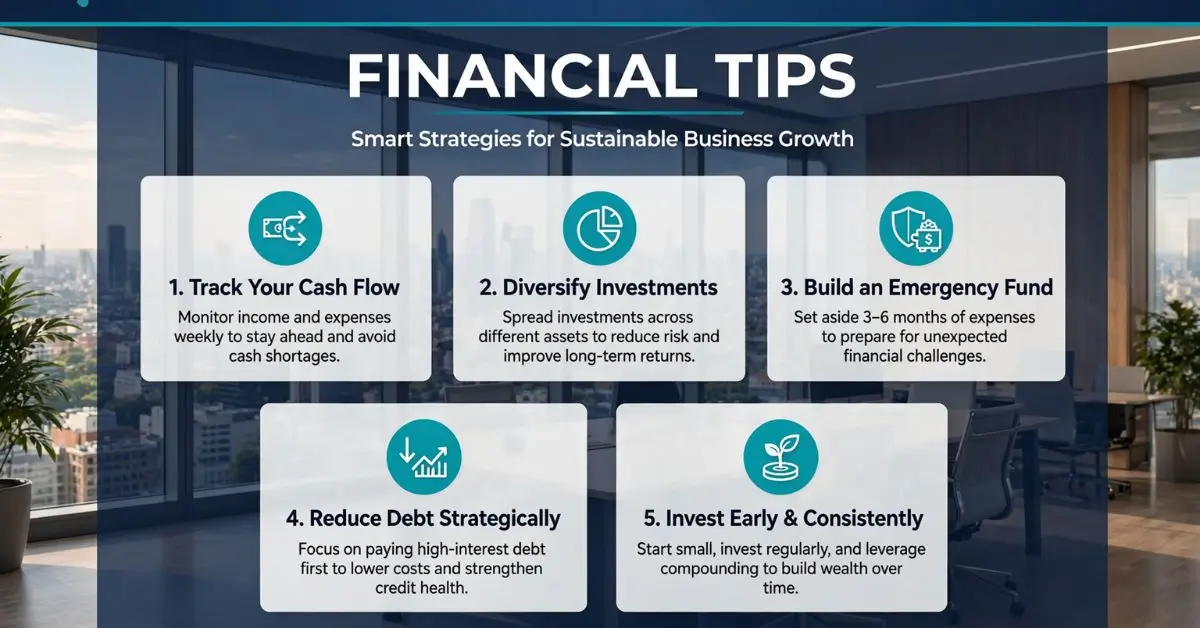
Three to six months of essential living expenses in a liquid, accessible account is the financial foundation that prevents every unexpected cost from derailing all other financial progress. A household with a fully funded emergency fund does not need to put car repairs on a credit card, take emergency personal loans, or stop retirement contributions when unexpected expenses occur.
Building this fund takes priority over investing in taxable accounts and paying extra on low-interest debt. Its presence changes the entire financial risk profile of a household by eliminating the most common mechanism through which financial progress gets reversed.
Financial Tip Category Three: Debt Management
Debt is not uniformly bad. Mortgage debt at a low fixed rate that builds equity in an appreciating asset is fundamentally different from credit card debt at 22% that finances consumption already consumed. Financial tips cwbiancamarket debt guidance makes these distinctions rather than treating all debt as equally problematic.
The high-interest debt elimination priority
Any debt carrying an interest rate above 8% to 10% is a guaranteed negative investment. Paying off a credit card balance at 22% interest produces a guaranteed 22% return on those funds, which is better than virtually any investment available. This makes high-interest debt elimination the highest-priority financial action for households carrying these balances alongside any investment ambitions.
The avalanche method, paying minimum payments on all debts while directing all additional payment capacity toward the highest-interest debt first, minimizes total interest paid. The snowball method, paying off the smallest balance first for psychological momentum, costs more in interest but produces the behavior reinforcement that some people need to sustain debt repayment. Both work. The avalanche saves more money. The snowball works better for people who need early wins to stay motivated.
Student loan and mortgage debt in context
Federally subsidized student loans at 4% to 7% interest and mortgage debt at current rates occupy a gray zone. Financial tips cwbiancamarket guidance on this type of debt recommends meeting employer retirement match contributions before making extra payments on these debts, because the guaranteed return from an employer match exceeds the interest rate being avoided.
Beyond the employer match, the priority between paying extra on moderate-interest debt versus investing in tax-advantaged accounts depends on individual tax situation, risk tolerance, and the specific interest rates involved. This is one area where individualized financial advice adds genuine value over general guidance.
Financial Tip Category Four: Investing for Long-Term Wealth
Most of the wealth that middle-income US earners accumulate over a lifetime comes not from extraordinary investment returns but from consistent investment over long periods. The mathematical reality of compound growth means that time is more valuable than investment selection for most investors.
Tax-advantaged accounts as the investment foundation
Financial tips cwbiancamarket investment guidance consistently prioritizes tax-advantaged accounts before taxable investing. 401(k) up to the employer match contribution is the first priority because the match is a 50% to 100% guaranteed return on those contributions before any investment return is considered.
After capturing the full employer match, a Roth IRA contribution up to the annual limit is typically the next priority for most earners below the income limits. Roth IRA growth and qualified withdrawals are tax-free, which produces significant long-term benefit relative to taxable account investing.
After maxing the Roth IRA, additional 401(k) contributions up to the annual limit provide further tax-deferred growth. Only after exhausting tax-advantaged account capacity does investing in taxable brokerage accounts make optimal sense.
Index funds as the practical investment vehicle
Decades of research consistently shows that broad market index funds outperform actively managed funds over long periods after fees are accounted for. Low-cost total market index funds from providers like Vanguard, Fidelity, and Schwab provide broad diversification, minimal fees, and returns that track overall market performance.
For a 30-year-old investor contributing $500 per month into a total market index fund earning historical average returns over 35 years, the projected outcome at age 65 is approximately $1.1 million. The same contribution into a fund with 1% higher annual fees produces approximately $900,000 at the same age. The $200,000 difference comes entirely from fees, not returns.
Building Financial Progress That Lasts
Financial tips cwbiancamarket guidance reflects a consistent underlying truth about personal finance. The financial strategies that build lasting wealth are not complicated. They are not available only to high earners or financial professionals. They are available to anyone who applies them consistently over time.
Automate savings before spending. Build an emergency fund that prevents financial backsliding. Eliminate high-interest debt aggressively. Capture employer retirement matches. Invest consistently in low-cost, diversified funds within tax-advantaged accounts.
None of these steps require advanced financial knowledge. All of them require consistent execution over years rather than brilliant decisions in single moments. The financial gap between people who build meaningful wealth and those who do not is almost entirely explained by these habits applied consistently, not by income level, investment sophistication, or fortunate timing.
Start with the first action in whichever category is most relevant to your current situation. Build from there with the same consistent approach.
Frequently Asked Questions
What financial tips does CWBiancaMarket cover?
CWBiancaMarket shares practical advice on budgeting, saving, debt management, and beginner-friendly investing.
What is the most important financial tip for beginners?
Automate your savings so money is set aside before you spend.
How much of my income should I save?
Aim to save around 20% of your income. If that’s not possible, start small and increase your savings over time.
What is the best way to pay off debt?
The avalanche method saves the most interest by paying off the highest-interest debt first, while the snowball method focuses on smaller balances for motivation.
Should I invest or pay off debt first?
Contribute enough to get your employer’s retirement match, then focus on paying off high-interest debt before investing more.
What is the best investment for beginners?
Low-cost index funds through a Roth IRA or similar retirement account are a popular choice for long-term investing.