
Socials and Softwares AlienSync: What It Is and How It Works
Managing social platforms and software tools separately is one of the most common productivity problems in the digital world today. You update something in one place, and it does not reflect somewhere else. You switch between apps constantly. Data gets lost between platforms. Workflows that should take minutes end up taking much longer.
This is exactly the kind of problem that AlienSync is designed to solve. It sits at the intersection of social media management and software integration — bringing different tools and platforms into a connected, synchronized system.
In this guide, you will learn what socials and softwares AlienSync actually means, how the platform works, who benefits from it most, and what to realistically expect from using it.
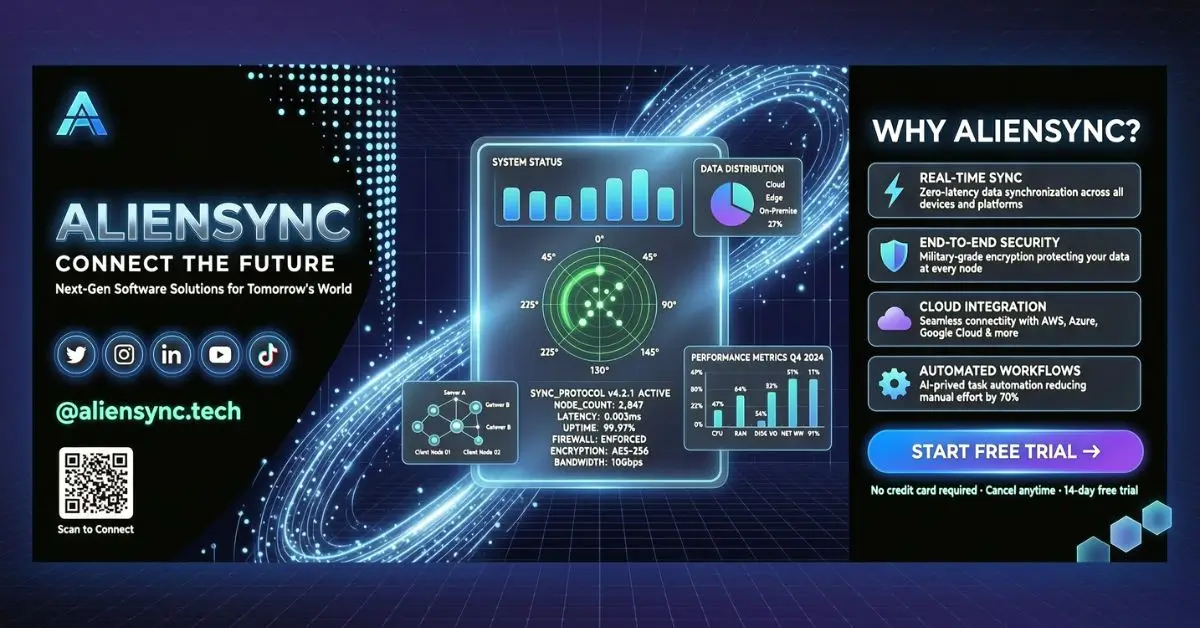
AlienSync is a digital synchronization platform that connects social media accounts and software tools into a unified workflow. It allows users to manage, automate, and coordinate activity across multiple platforms from a single interface — reducing manual work, minimizing errors, and keeping data consistent across connected tools and channels.
Quick Summary
AlienSync brings your social platforms and software tools together so they work as one connected system instead of separate, isolated apps. It is built for individuals, teams, and businesses that want to reduce manual work and keep everything in sync without constant switching between platforms.
The Real Problem With Disconnected Tools
Before understanding what AlienSync offers, it helps to understand the problem it is solving — because it is a problem most digital users know well.
The average professional today uses multiple tools to get work done. There are social media platforms for communication and marketing. There are project management tools, CRM systems, analytics dashboards, content schedulers, and collaboration software. Each one works well on its own.
The problem is they rarely talk to each other naturally. You end up doing the same task in two or three different places. Data sits in silos. Automations break. And the time spent managing tools starts to outweigh the time spent actually using them productively.
That is the gap that socials and softwares AlienSync is built to fill.
What AlienSync Actually Does
At its core, AlienSync creates connections between platforms and tools that would otherwise operate independently. Think of it as a bridge — or more accurately, a network of bridges — linking your social accounts and software in ways that allow them to share data, trigger actions, and stay updated automatically.
Here is what that looks like in practice:
Social media synchronization: AlienSync can connect multiple social accounts — Instagram, X (formerly Twitter), LinkedIn, Facebook, and others — so that content, updates, or data changes can flow between them based on rules you set up. Instead of posting separately to each platform, the system handles distribution based on your configuration.
Software integration: Beyond social media, the platform connects with software tools your team already uses. That might include email marketing platforms, analytics tools, e-commerce systems, or CRM software. When something changes in one system, AlienSync can trigger an update or action in another.
Workflow automation: This is where the real time savings come from. You define what should happen when a specific trigger occurs — a new follower, a form submission, a completed task — and AlienSync handles the rest without you needing to manually intervene each time.
Centralized dashboard: Instead of logging into five different platforms to check what is happening, AlienSync brings key data and controls into one view. This alone reduces the mental load of managing a complex digital setup.
Who Benefits Most From AlienSync
The platform is flexible enough to serve different types of users, but some get more value from it than others.
Social media managers: People who manage multiple accounts for multiple clients spend enormous amounts of time on repetitive tasks. AlienSync reduces that repetition significantly by automating cross-platform actions and keeping accounts in sync.
Small business owners: A business owner in Denver running an online store, a social presence, and an email list is essentially managing three separate systems. With AlienSync, those systems can talk to each other — a new customer in the store can automatically trigger an email welcome sequence and a social engagement action without any manual work.
Marketing teams: Teams that run campaigns across multiple channels benefit from synchronized data. When your analytics tool, CRM, and social platforms share data automatically, your reporting becomes more accurate and your decisions get faster.
Content creators: Creators who publish across YouTube, Instagram, a blog, and a newsletter can use AlienSync to coordinate distribution without manually updating every channel every time.
Developers and agencies: For technical users building client solutions, AlienSync offers integration capabilities that reduce custom development time when connecting common platforms.
How the Social and Software Integration Actually Works
The technical side of AlienSync does not need to be complicated to understand. The platform works on a trigger-and-action model, which is a common approach in automation tools.
You start by connecting your accounts and software tools to the platform. This usually involves granting permission through an authentication process — the same way you connect any app to your Google or social accounts.
Once connected, you build workflows by setting up triggers and actions:
- Trigger: Something that happens in one platform (a new post goes live, a sale is completed, someone fills out a form)
- Action: Something that should happen automatically in response (notify a team member, update a CRM record, post to a social channel, send an email)
The real power comes from chaining multiple actions to a single trigger, or building multi-step workflows where one action feeds into the next.
For example, a marketing team might set up a workflow where a new blog post published on their website automatically creates a scheduled social post on LinkedIn and Twitter, adds the post URL to a content tracking spreadsheet, and sends a Slack notification to the content team. One trigger, multiple automated actions, zero manual steps.
Key Features at a Glance
| Feature | What It Does |
|---|---|
| Multi-platform social sync | Connects and coordinates multiple social accounts |
| Software integrations | Links tools like CRMs, email platforms, and analytics |
| Trigger-based automation | Automates actions based on events across platforms |
| Centralized dashboard | Manages everything from one interface |
| Data consistency | Keeps information aligned across connected systems |
| Custom workflow builder | Create specific automations for your exact needs |
Honest Pros and Cons
No platform is perfect for every user. Here is a straightforward look at both sides.
What works well:
The time savings from automation are real and significant. Once workflows are set up correctly, they run without manual input. The ability to connect social media and software tools in one place also reduces context-switching, which is one of the biggest hidden productivity costs in modern work.
The centralized dashboard makes it much easier to get a clear picture of what is happening across your digital ecosystem without jumping between tabs and apps.
What to be aware of:
Like most automation platforms, AlienSync has a learning curve. Setting up complex workflows takes time upfront. If your integrations are not configured correctly, you can end up with duplicated actions or missed triggers. It requires regular monitoring — especially in the early stages — to make sure everything is behaving as expected.
Also, the value you get depends heavily on how many tools you are connecting. If you only use two or three platforms, the benefit is smaller. The more tools you have in your workflow, the more valuable synchronization becomes.
Getting Started: A Practical Approach
If you are new to socials and softwares AlienSync, the best approach is to start simple and build from there.
Step 1: Map your current tools. Before setting up anything, write down every social platform and software tool you use regularly. This gives you a clear picture of what needs to be connected.
Step 2: Identify your biggest pain points. Where do you spend the most time on repetitive manual tasks? Start with automating those first. Quick wins early in the setup process keep you motivated and help you learn how the platform works.
Step 3: Connect your highest-priority platforms first. Do not try to integrate everything at once. Connect your two or three most-used tools and build working automations before adding more.
Step 4: Test every workflow before relying on it. Run test scenarios to make sure your automations trigger correctly and produce the right actions. Catching a misconfiguration during testing is far better than discovering it after it has caused a problem.
Step 5: Review and optimize regularly. Your workflow needs change over time. Schedule a monthly review to check which automations are still useful and which ones need updating.
What Makes AlienSync Different From Similar Tools
There are other platforms in the synchronization and automation space — tools like Zapier, Make (formerly Integromat), and Buffer come to mind. So what makes socials and softwares AlienSync worth considering specifically?
The key difference is focus. While general automation tools like Zapier handle thousands of different app connections broadly, AlienSync is positioned specifically around social media and software workflows. That focus means the social-specific features tend to be more refined and more relevant to users whose primary need is managing a connected social and digital tool ecosystem.
For users whose work revolves around social platforms combined with supporting software, that specialization often makes the platform more intuitive and more effective than a general-purpose automation tool.