

Introduction
You’ve got a gamepad in your hand and you just want it to work. But the connection isn’t pairing, the device isn’t recognizing it, or you’re not even sure which connection mode to use. This is a common frustration and it’s almost always fixable once you understand how the connectivity on the HSS gamepad actually works.
What is the connectivity HSSgamepad?
The HSS gamepad is a multi-platform gaming controller designed to connect wirelessly or via a wired connection to smartphones, tablets, PCs, and other compatible devices. Its connectivity system supports Bluetooth, a 2.4GHz wireless receiver, and a USB wired mode giving users multiple options depending on their setup and gaming needs.
This guide explains each connection method clearly, walks you through setup for different devices, and covers the most common connectivity problems and how to fix them.
Quick Summary
The HSS gamepad supports three connection types Bluetooth, 2.4GHz wireless, and USB wired. Each works differently and suits different setups. This guide covers how to connect it to your phone, PC, or tablet, and how to fix it when the connection drops or doesn’t work.
Understanding the HSS Gamepad Connectivity System
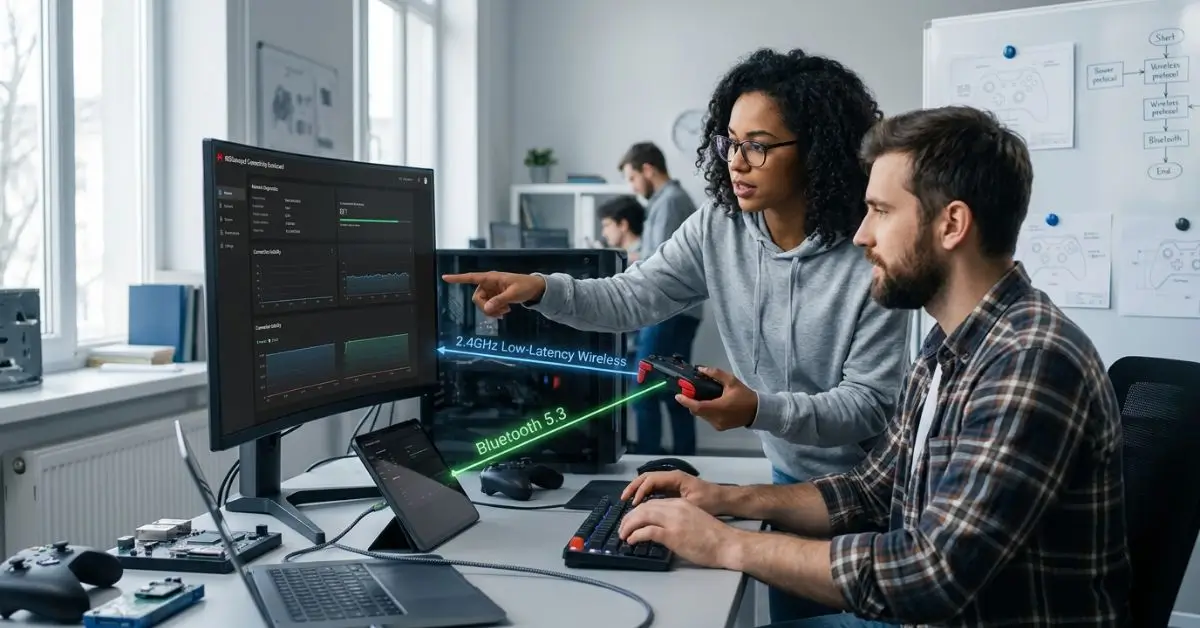
Not all gamepads are built the same. Some only support Bluetooth. Others are wired only. What makes the connectivity HSSgamepad stand out in its price range is the three-mode connection system.
Here’s what that means in practice:
Bluetooth mode connects directly to your device without any extra hardware. Good for phones, tablets, and laptops that have Bluetooth built in.
2.4GHz wireless mode uses a small USB dongle that plugs into your device. This connection is generally faster and more stable than Bluetooth less input lag, less chance of interference.
USB wired mode plugs the gamepad directly into your device with a cable. Zero wireless interference. Instant recognition on most systems.
Each mode has its place. Understanding which one fits your situation is the first step to getting a smooth connection.
How to Connect the HSS Gamepad via Bluetooth
Bluetooth is the most flexible option because it doesn’t require any extra hardware. Here’s how to connect it step by step.
Step 1 — Turn on Bluetooth mode. Hold the Bluetooth button on the gamepad until the indicator light starts flashing. On most HSS gamepad models, this is a dedicated button labeled with a Bluetooth symbol, usually near the center or top of the controller.
Step 2 — Open Bluetooth settings on your device. On Android, go to Settings, then Bluetooth. On iOS, go to Settings, then Bluetooth. On Windows 10 or 11, go to Settings, then Devices, then Bluetooth.
Step 3 — Search for the device. Your device should detect the gamepad as “HSS Gamepad” or a similar name. Tap or click it to pair.
Step 4 — Confirm the connection. The flashing light on the gamepad should go solid once paired successfully.
If you’re connecting to an Android phone in the US — say, a Samsung Galaxy running Android 13 — this process typically takes under 30 seconds. The gamepad shows up quickly and pairs without needing a PIN.
One thing to note: Bluetooth connections can sometimes drop if your phone’s battery saver mode limits background processes. If your connection keeps disconnecting, check whether battery optimization is affecting Bluetooth on your device.
How to Connect Using the 2.4GHz Wireless Dongle
This is the preferred method for PC gaming and for anyone who wants the most stable wireless connection possible.
Step 1 — Plug the USB dongle into your device. The 2.4GHz receiver is a small USB stick that usually comes stored in the gamepad itself — check the battery compartment or the back panel.
Step 2 — Switch the gamepad to 2.4GHz mode. There’s typically a mode switch button or slider on the gamepad. Set it to the 2.4GHz position.
Step 3 — Turn the gamepad on. The dongle and gamepad should sync automatically. No pairing process required — they’re pre-paired from the factory.
Step 4 — Check your PC recognizes it. On Windows, it should appear under Devices and Printers as a game controller. You can also verify it’s working by going to Control Panel, then Devices and Printers, then right-clicking the gamepad and selecting “Game controller settings.”
The 2.4GHz connection works at a range of approximately 8–10 meters in most indoor environments. Walls and other wireless devices can reduce this slightly, but in practice it’s reliable for most home setups.
How to Connect via USB Wired Mode
Wired is the simplest option and the one with zero connectivity issues. If Bluetooth or 2.4GHz isn’t working, wired mode will almost always solve the problem.
Step 1 — Connect the USB cable. Plug one end into the gamepad and the other into your device. Most HSS gamepad models use a USB-C or Micro-USB cable.
Step 2 — Switch to wired mode. Some models switch automatically when a cable is plugged in. Others require you to press a mode button.
Step 3 — Wait for device recognition. On Windows, the gamepad is usually recognized within a few seconds without needing to install drivers. On Android, you may need an OTG adapter if your phone doesn’t have a standard USB-A port.
Wired mode is particularly useful for emulation setups, fighting games where input timing matters, or any situation where even slight wireless latency is a problem.
Which Connection Mode Should You Use?
| Connection Mode | Best For | Stability | Setup Effort |
|---|---|---|---|
| Bluetooth | Phones, tablets, laptops | Good | Low |
| 2.4GHz Wireless | PC gaming, TV boxes | Very good | Low |
| USB Wired | PC, competitive gaming | Excellent | Minimal |
If you mostly game on your phone, Bluetooth is fine. If you game on a PC and want the best performance, use the 2.4GHz dongle. If you want zero fuss and maximum reliability, plug in the cable.
Device Compatibility: What Works with the HSS Gamepad
The HSS gamepad is designed to work across multiple platforms. Here’s a clear breakdown:
Android phones and tablets — Full support. Works via Bluetooth and USB (with OTG). Compatible with most mobile games that support external controllers, including emulators.
Windows PC — Full support. Works via all three connection modes. Recognized as an XInput or DirectInput controller depending on the mode and driver.
iOS and iPadOS — Partial support. Bluetooth pairing works on iOS 13 and later. Not all iOS games support external gamepads, so check your specific game before assuming it will work.
Smart TVs and Android TV boxes — Generally works via 2.4GHz dongle or Bluetooth. Useful for streaming gaming services or emulation on a TV setup.
Nintendo Switch, PlayStation, Xbox — The HSS gamepad is not designed as a replacement controller for dedicated consoles. It may work in limited ways but is not officially compatible.
Common Connectivity Problems and How to Fix Them
Even with a well-built gamepad, connection issues happen. Here are the most common problems and straightforward fixes.
Gamepad won’t pair via Bluetooth.
Hold the pairing button longer — usually 3–5 seconds until the light flashes rapidly. Make sure the gamepad isn’t already connected to another device. Bluetooth devices can only maintain one active connection at a time.
Connection keeps dropping.
Check for wireless interference. Microwaves, routers, and other Bluetooth devices can all disrupt a 2.4GHz or Bluetooth signal. Try moving closer to your device or switching to wired mode.
PC doesn’t recognize the gamepad in wired mode.
Try a different USB port. Some USB hubs don’t provide enough power. Plug directly into a port on the PC itself. If the problem continues, check Device Manager for any driver errors.
Buttons aren’t responding correctly in a game.
This is usually a controller mapping issue, not a connectivity problem. Use a tool like DS4Windows or Steam’s controller configuration to remap buttons to match what the game expects.
Gamepad connects but has input lag.
Switch from Bluetooth to 2.4GHz wireless or wired mode. Bluetooth has slightly higher latency by nature. For fast-paced games, the difference matters.
Tips for Keeping Your HSS Gamepad Connection Stable
A few simple habits make a real difference:
Keep the firmware updated if your gamepad model supports it. Some HSS models have companion apps that push updates.
Store the USB dongle in the gamepad when not in use. Losing the 2.4GHz receiver means losing that connection mode entirely.
Keep the gamepad charged. A low battery causes inconsistent connectivity — the gamepad may connect and then drop the signal as the battery drains.
Re-pair the Bluetooth connection if you switch between devices frequently. Constantly switching between your phone and your tablet can cause pairing conflicts.
Conclusion
The connectivity HSSgamepad gives you real flexibility for the price. Three connection modes, broad device support, and a straightforward setup process make it a practical choice for mobile gamers, PC players, and anyone building a home emulation setup.
The key is matching the right connection mode to your situation. Bluetooth for phone gaming, 2.4GHz for PC and TV setups, wired when you want zero fuss. Once you’ve got that right, most connection problems disappear.
If you’re setting up a full gaming station at home, you might also find it useful to read about the best Android games that support external controllers, or how to set up a PC gaming station on a budget — both topics that pair directly with getting the most from your gamepad.
Frequently Asked Questions
What devices does the HSS gamepad connect to?
It connects to Android phones, tablets, Windows PCs, laptops, smart TVs, and Android TV boxes via Bluetooth, 2.4GHz wireless, or USB. iOS works via Bluetooth but with limited app support. Android and Windows offer the most reliable experience overall.
Why won’t my HSS gamepad connect to my phone?
It’s likely still paired to another device. Hold the pairing button for 8–10 seconds to reset it, then pair again from scratch. If that doesn’t work, test with a USB cable and OTG adapter to rule out a hardware problem.
Is the HSS gamepad good for PC gaming?
Yes. It works well on Windows via the 2.4GHz dongle or USB cable. For older games that only recognize Xbox controllers, use DS4Windows to make it appear as one. Wired mode gives the best performance for fast or competitive games.
How do I switch between connection modes?
Use the mode switch button or slider near the top of the controller. The LED light changes color or blink pattern to confirm which mode is active. Check your specific model’s manual since button layout varies slightly.
Does the HSS gamepad have input lag?
Bluetooth adds roughly 8–15ms of latency — fine for casual play but noticeable in fast games. The 2.4GHz mode drops this to around 4–8ms. Wired mode has the lowest lag of all three. For competitive gaming, skip Bluetooth.