

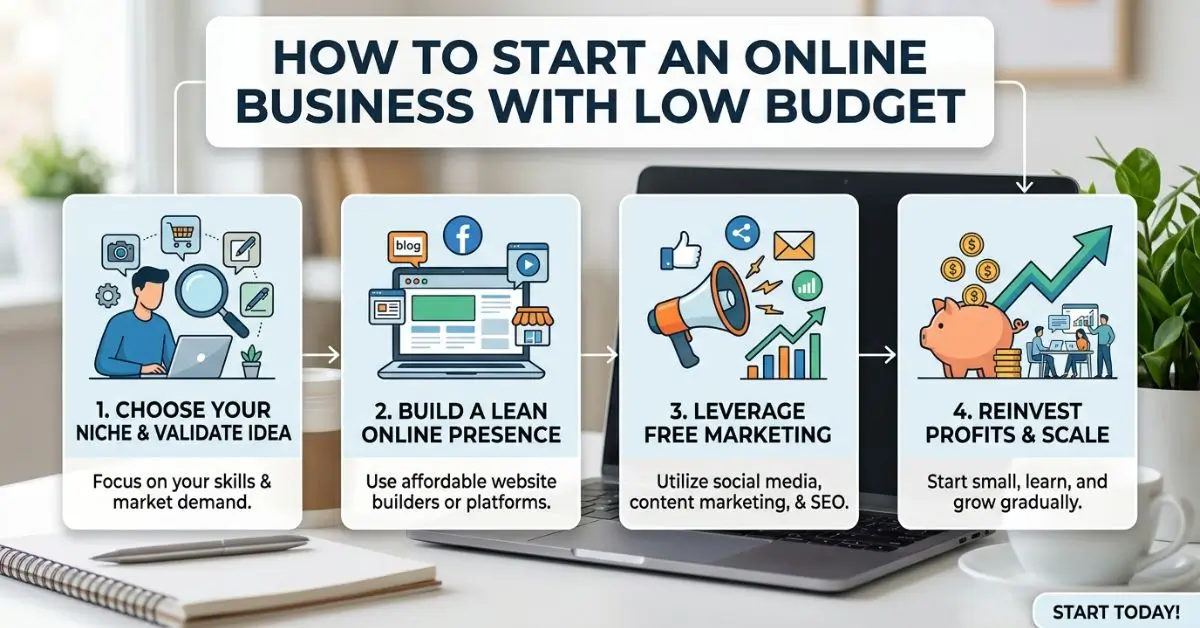
How to Start Online Business With Low Budget
A lot of people want to start an online business, but most stop before they begin. The reason is simple: they think they need a big budget, a perfect website, paid ads, and a full brand from day one.
That is not true.
If you are trying to figure out how to start online business with low budget, the smarter move is to start lean. You do not need a fancy setup. You need a simple offer, the right tools, and a way to get your first customer fast.
Starting an online business with a low budget means launching a digital product, service, store, or content-based brand using low-cost tools, lean marketing, and simple systems. Instead of spending heavily on inventory, office space, or ads, you validate demand first, sell early, and grow step by step. The goal is profit, not a fancy setup for first-time founders at launch.
In this guide, you will learn what business models cost the least, what to avoid, how to validate your idea, what tools actually matter, and how to get your first sales without burning cash.
Quick Summary
Start with a low-cost business model like services, digital products, or affiliate content. Validate demand before you build. Use simple tools, keep your setup lean, and focus on getting your first paying customer before you spend on branding or ads.
Start With the Right Business Model
The biggest mistake beginners make is choosing a business model that needs too much money upfront.
If your budget is tight, avoid anything that requires large inventory, custom app development, or heavy paid advertising. Those models can work later, but they are not the best place to begin.
The smartest way to approach how to start online business with low budget is to choose a model that lets you sell quickly and keep risk low.
Here are the best low-cost options:
- Freelance services
Writing, design, bookkeeping, SEO, virtual assistance, editing, and social media management are all low-cost to start. You mainly need a skill, a simple portfolio, and a way to reach clients. - Digital products
Templates, e-books, printables, mini-courses, spreadsheets, and planners can be created once and sold many times. - Affiliate content
You create content around a niche and earn commission when people buy through your links. It takes time, but startup costs are low. - Print on demand
You sell T-shirts, mugs, posters, or notebooks without holding inventory. It is easier to launch than traditional ecommerce, but margins are lower. - Online coaching or consulting
If you already have experience in fitness, resumes, job search, marketing, finance, or language learning, this can be a strong option.
Best Low-Budget Online Business Models
| Business Model | Typical Startup Cost | Speed to First Sale | Best For | Main Downside |
|---|---|---|---|---|
| Freelance services | $50–$200 | Fast | People with a usable skill | Income depends on your time |
| Digital products | $50–$300 | Medium | Creators and educators | Takes time to build trust |
| Affiliate content | $50–$200 | Slow | Writers, reviewers, niche site builders | Needs patience and traffic |
| Print on demand | $100–$400 | Medium | Design-focused beginners | Lower profit margins |
| Coaching/consulting | $50–$250 | Fast | Experienced professionals | You must prove credibility |
If you want to know how to start online business with low budget, notice the pattern: the cheapest models usually sell skill, knowledge, or digital files. They do not tie up money in stock.
Validate Demand Before You Build Anything
This step saves money.
Too many people spend weeks creating a logo, building a website, and setting up social profiles before they know if anyone wants what they are selling. That is backward.
Before you build, test demand.
Here is a simple way to do it:
- Search the topic on Google and YouTube
- Check Reddit threads and Facebook groups
- Use Google Trends to see if interest is steady
- Search Etsy, Amazon, Gumroad, or Fiverr to see what already sells
- Read reviews to spot what buyers like and what they still complain about
If people are already spending money in that space, that is a good sign.
For example, if you want to sell resume help, look at job seeker groups, Fiverr listings, LinkedIn posts, and resume template shops on Etsy. You will quickly see which services are crowded, which ones are weak, and where you can stand out.
The goal is not to find a market with no competition. The goal is to find a market with real demand and room for a better offer.
Pick One Customer and One Problem
A broad idea sounds safe, but it usually fails.
“Marketing services for everyone” is weak.
“Instagram content help for local real estate agents” is stronger.
“Printable planners” is broad.
“Meal-planning templates for busy moms” is clearer.
People buy faster when they feel like the offer was made for them.
This matters a lot when learning how to start online business with low budget, because you do not have money to market to everyone. You need a narrow message that clicks fast.
Ask yourself:
- Who is this for?
- What problem am I solving?
- Why would someone pay for this now?
- What result can I promise clearly?
A focused offer is easier to sell, easier to explain, and cheaper to market.
Keep Your First Offer Simple
Your first offer does not need to be big.
In fact, smaller is better.
If you are selling a service, package it into one clear outcome. Instead of offering “full digital marketing,” sell a monthly email newsletter setup, a LinkedIn profile rewrite, or five branded social posts per week.
If you are selling a digital product, start with one useful item. Do not build a 60-page course when a clean spreadsheet, checklist, or template pack could sell first.
A simple offer helps you launch faster and learn what buyers actually want.
That learning is valuable. It tells you what to improve, what to cut, and what people will pay more for later.
Build a Lean Online Presence
People searching how to start online business with low budget often assume they need a full website right away. Most do not.
What you need depends on your business model.
Here is the lean version:
- Freelancers: One-page website or portfolio link
- Digital products: Gumroad, Etsy, or Payhip
- Print on demand: Etsy + Printify or Shopify + Printful
- Consultants/coaches: Simple website + booking link
- Affiliate creators: Blog, newsletter, or YouTube channel
A clean one-page site can be enough at the start. Include:
- What you do
- Who you help
- One clear offer
- Social proof if you have it
- Contact form or buy button
You can build this with low-cost tools like Carrd, WordPress, or Squarespace.
Do not spend weeks choosing fonts and colors. Clear beats fancy.
Use Cheap Tools That Actually Matter
Low budget does not mean using bad tools. It means paying only for tools that move the business forward.
Here is what usually matters early:
- Domain name: Good to have if you want to look serious
- Email: A branded email helps for client work
- Canva: Great for basic design, lead magnets, and product images
- Google Docs / Sheets: Enough for many businesses
- Stripe or PayPal: Easy payments
- Notion or Trello: Keeps tasks organized
- Zoom or Google Meet: For calls
- Linktree or simple landing page tools: Useful if most traffic comes from social media
Here is what you can usually skip at the start:
- Expensive branding packages
- Premium CRM tools
- Advanced automation software
- Paid ad tools
- Too many subscriptions
A real business does not look “real” because it has 12 tools. It looks real because it solves a real problem and makes sales.
Handle the Basic Legal and Money Setup
This part is boring, but it matters.
In the US, many people start as a sole proprietor and move to an LLC later if the business grows or risk increases. That is common and practical. But the right setup depends on your state, income, and liability risk.
At minimum, do these things:
- Keep business and personal money separate
- Track income and expenses from day one
- Save receipts
- Use one payment system consistently
- Check local and federal tax rules
If you are in the US, the SBA and IRS are the best places to check official basics. If you are in the UK or Canada, use the official government business portals for tax and registration rules.
Be honest with yourself here: if you ignore the money side early, it becomes a bigger mess later.
Focus on Free Traffic First
A big part of how to start online business with low budget is learning how to market without relying on ads.
Free traffic is slower than paid traffic, but it is better for beginners because it teaches you what people respond to.
The best low-cost marketing channels are:
- SEO content
- Short-form video
- Pinterest for visual products
- Email newsletters
- LinkedIn for B2B services
- Facebook groups and communities
- Cold outreach, if done well
Let’s say you are a freelance bookkeeper in Dallas. You could post short LinkedIn tips for small business owners, share a simple tax prep checklist, and send direct outreach to local service businesses. That is far cheaper than paying for ads before you know your message works.
The rule is simple: first learn what gets attention. Then learn what gets replies. Then learn what gets sales.
Launch Fast and Get Your First Customer
Do not wait until everything feels perfect. That day rarely comes.
Your goal is not a perfect launch. Your goal is a real launch.
Here is a simple launch plan:
- Create one offer
- Build one sales page or profile
- Publish three to five pieces of content
- Reach out to people directly
- Ask for one sale, one review, or one test client
If you offer services, your first customers may come from direct outreach, your network, referrals, or freelance platforms.
If you sell digital products, your first customers may come from Etsy, niche Facebook groups, Pinterest, or email.
If you build content, your first win may be an email signup, not a sale. That is fine. Momentum matters.
Many beginners overthink scale before they prove demand. That is backward. A big part of how to start online business with low budget is getting proof first, then investing later.
Reinvest the First Money Carefully
Once money starts coming in, spend it where it removes friction.
Good first upgrades often include:
- Better landing page
- Better product visuals
- Better microphone or camera if content is your growth channel
- One paid tool that saves real time
- Contractor help for repetitive tasks
- Basic bookkeeping support
Bad early upgrades include:
- Rebranding too soon
- Buying several courses at once
- Running ads without a tested offer
- Paying for software you barely use
Reinvestment should make the business simpler, faster, or more profitable. If it does not, wait.
Common Mistakes to Avoid
Low-budget startups fail for simple reasons more often than complex ones.
Here are the biggest mistakes:
1. Starting with the logo
A logo is not the business. Demand is the business.
2. Trying to sell to everyone
Broad offers are harder to sell and harder to market.
3. Buying too many tools
Subscriptions pile up fast. Most beginners do not need them.
4. Avoiding direct sales
Posting content is useful, but direct outreach often gets the first customer faster.
5. Building too much before testing
A small offer sold today beats a big offer nobody wants next month.
6. Expecting fast passive income
Some models become passive later. Most are active at the start.
7. Quitting too early
Many low-cost online businesses start slowly. That is normal.
A Realistic Starter Budget
Let’s be honest: “start with zero dollars” makes a good headline, but it is not always practical.
A more realistic starting range is:
- Service business: $50–$200
- Digital products: $50–$300
- Affiliate site or newsletter: $50–$200
- Print on demand: $100–$400
That budget usually covers a domain, basic software, product mockups, payment setup, and a few tools.
You do not need to spend all of it on day one. In fact, you should not. Spend in stages.
That is the real answer to how to start online business with low budget: protect cash, test fast, and only pay more when results justify it.
What a Smart Low-Budget Path Looks Like
If you feel stuck, follow this simple order:
- Pick one model
- Pick one audience
- Create one offer
- Validate demand
- Launch with basic tools
- Get one paying customer
- Improve from feedback
- Reinvest carefully
That order works because it keeps your risk low.
The goal is not to look big. The goal is to become profitable.
A small business with real customers is stronger than a polished business with no sales.
Conclusion
Starting small is not a weakness. It is often the smartest way to build.
If you are serious about learning how to start online business with low budget, do not chase perfection. Pick a simple model, solve one real problem, and get to your first sale with as little waste as possible.
You can always improve later. What matters now is starting with a plan that fits your money, your skills, and your time.
If this guide helped, save it and use it like a checklist while you build. A lean start today is better than waiting another six months for the “perfect” moment.
Frequently Asked Questions
Can I start an online business with just $100?
Yes. A service business, digital product, or affiliate project can start with around $100 if you keep tools lean and skip paid ads. Focus on a domain, basic landing page, and one payment tool. Do not spread the budget across too many subscriptions.
What is the cheapest online business to start?
Freelance services — writing, design, virtual assistance, tutoring — are the cheapest because you are selling a skill, not buying products. Digital products are also low-cost but take longer to gain traction without an existing audience.
Do I need an LLC before I start?
No. Most US beginners start as sole proprietors and move to an LLC later if needed. What matters early is tracking income, separating business money, and checking local tax rules. An LLC can wait until growth makes it necessary.
Should I build a website first or sell through a marketplace?
Start with a marketplace. Etsy, Fiverr, Gumroad, or Upwork give you traffic and trust faster than a new website. Build your own site once you know your offer works and want more control over your brand.
How long does it take to make money?
Services can pay within weeks. Affiliate and content models can take months. The fastest path is a clear offer, a specific audience, and direct outreach — not waiting for traffic to build on its own.
Is print on demand still worth it in 2026?
Yes, but only with a focused niche and strong designs. Margins are lower than services or digital products. Treat it like a real brand not a side experiment — and it can still work well.